Wednesday, 8 May 2013

Edinburgh - part 2

Here are some pieces of trivia about Edinburgh that our guide, Marion, shared with us - in no particular order of importance.

-We all know that J.K. Rowling wrote the first of the Harry Potter books sitting at a coffee shop with her young son. What I certainly didn't know was that she wrote the last of the series while living at the 5 Star Balmoral Hotel on Princes St in Edinburgh.

-The town of Leith at the seaside on the outskirts of Edinburgh, was were the first rules of golf were laid down.

-Many people have heard of the Edinburgh Festival that attracts performing artists from around the world, but did you know that they also host annually the world's biggest Book Festival?

-Fettes College is a prep school that Ian Fleming, creator of the James Bond series attended  (among many others with names that you would recognize). Sean Connery, the first actor to portray James Bond also has a connection with Fettes College: he used to deliver the milk there.

Our first stop was at Edinburgh Castle, which is described as "The Iconic Scottish Tourist Attraction" and I'll grant you, it's BIG. This is a view of the city through one of the cannon ports on the battery.

I've come to realize that watching Braveheart, and a 2-hour DVD of Billy Connolly humour was not enough preparation for appreciating the finer points of the Scottish history and psyche. Despite the fact that it's a bit difficult to keep the characters and battles and allegiance in their appropriate centuries, I was fascinated by the layers of history that the castle encompasses especially in the Military Museum and a special section on the role of castle as a facility for prisoners of war as recently as the 19th century. The tour included the birth chamber of James VI of Scotland/James I of England, and even a dog cemetery on the grounds. I certainly can't do it justice but it was a visit that was essential to feel the full Edingburgh experience.


 One of the wonderful things about traveling with a guides is that not only do you get to observe interesting aspects of the unfamiliar world around you, but you have someone to explain it to you. This is a workman at Edinburgh Castle who is repairing the stonework of a crow step gable, very aptly named for the ledges that the great stones form along the gable.
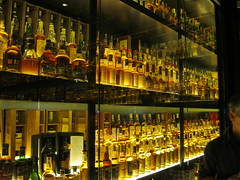
Speaking of the full Scottish experience, just below the gates of the castle is an enterprise known as The Scotch Whiskey Experience, where you literally ride through the process of brewing Scotch whiskey, smelling the peat fires that can give it a smokey taste, to being in the vat and voyaging among the yeast bubbles. It's actually great fun. We proceeded to an area where the guide explained about the 4 main regions of the country where Scotch whiskey is distilled, and the differences in their tastes. Then on to the tasting room, shown here with the world's largest collection of Scotch whiskey bottles: all unopened, some over 100 years old.


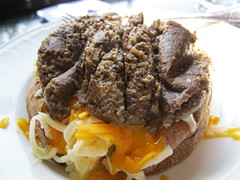
Let me introduce you to my lunch at Auld Jock's Pie Shoppe: This is a "potato jacket" with cheese and haggis. It was actually wonderful, but let's face it, anything would taste great with 2 cups of grated cheese. The haggis actually reminded me of a nicely spiced meat layer of shepherd's pie.


One of the great things for tourism is that all of the public museums have free admission, with a suggested donation bin at the entrance. This means that you can pop into any gallery for 20 minutes, soak up some culture and beauty and be on your way. This is what I did after coming down from the Old Town. I took a little tour of of some of the rooms of the older Scottish painters in the Scottish National Gallery. I was stunned to walk into a magnificent salon and discover Auguste Rodin's The Kiss commissioned by E.P. Warren, an eccentric American collector. What a gift to see such a masterpiece within touching distance.

Tuesday, 7 May 2013

The Scottish Borders

This was our first "driving through the countryside" day where we spent more time on the bus knitting and appreciating the beautiful rolling hills than we did walking around. Quite a few sheep in those hills with 2 lambs for every ewe. Some looked like they'd hardly had time to dry off.
The Scottish Borders is the name given to the region south of the Glasgow/ Edingburgh corridor, closer to the border with Britain where historically family allegiance was primordial, then allegiance to whichever was the winning side in the "reiving".
Whereas the vast majority of names from the north begin with the letter M, in this region there is more diversity:  Elliot, Armstrong, Nixon, Crosier, Scott, Little, Bell, Graham, Johnstone to name a few.

The first stop was at WOOLFISH, near the village of St Abb's. The owner Louise, her daughter Trudi and son-in-law Nathan run an absolutely magnificent operation. They welcomed us to their home with tea, coffee and hot homemade scones.


From their lovely house in the countryside they run a yarn haven/store, B&B and workshop space for knitting retreats.Lots of hard work no doubt, but everyone's dream job.
Above is only one of the rooms where the yarn stock is displayed. Louise has a history across the needle arts spectrum having taught embroidery, crewel, knitting and lots more. Lots of treasures to be found among the shelves.

This is the town of Melrose where we stopped for lunch. It has the requisite abbey  that virtually every town seems to have (either ruined or defunct), a great pub with fabulous chips, a terrific independent bookshop where I picked up my first Ian Rankin novel, and hundreds of other quaint attractions that call coach tours from all over for daytrips - somewhat like Westport north of Kingston.
Our final stop was at Johnstons of Elgin (although we were in the Hawick outlet) for a tour of the cashmere knitting mill operation. We were lucky that they were working with a skeleton crew, Monday being a "Bank Holiday". In that industrial environment we wouldn't have heard a word the guide was saying.
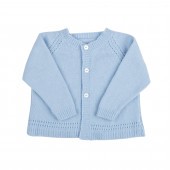
She explained that all of the adult garments were machine knit but that most of the baby garments, like this little cardigan, are hand knit by ladies in the Elgin area. The cashmere jacket would sell for about $110 and the matching knitted blanket would be $190 for some very special baby.

Monday, 6 May 2013

Edinburgh - part 1


We arrived in Edinburgh today, Sunday. It's so nice to see the daffodils in full bloom, but as you can see the trees are still rather naked. We're speculating as to how far advanced the leaves will be when we get home next week.


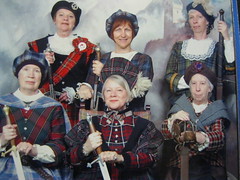
 Our first stop was to the Tartan Weaving Mill and Exhibition at the gates of Edinburgh Castle, (which is on our slate to visit on Tuesday). As part of the visit we had a lot of fun dressing in the attire of another era. Those swords really are quite heavy!


One of the highlights of any tour has to be the meals.  Here we are at The Mercure Hotel for lunch.It was right in the centre of town and is fronted by the magnificent Princes St Gardens which are much more colourful than anything we left back home, despite the cold spring they've had in Scotland .
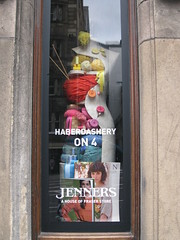
After lunch we met the coach driver around the corner and discovered Jenners, a high end department store that consecrated two windows on the ground floor to knitting and crafts in general. I was stunned! It would be like coming across such a window at Holt-Renfrew.

On Tuesday we have an afternoon free to explore the city and do some shopping. I'll be heading to Jenners and John Lewis, another quality department store that apparently has a sizable yarn department.There are 3 other LYSs in the general area that we're all hoping to visit.

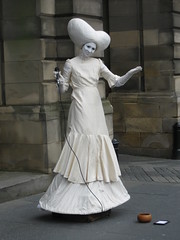
Edinburgh is a wonderful city, full of culture and art. This lady was busking on the Royal Mile and kindly posed for me. I put a coin in her bowl and she began singing a beautiful Gaelic tune. It occurred to me that this was a very sensible way to busk: reward your patrons only when they've put money in your bowl, that way they can't listen to the beautiful performance then walk on.

Saturday, 4 May 2013

Paisley Weaving etc.


Most of the English speaking world associates the word Paisley with the tear drop shape and its turned over end found in so many fabric and tapestry designs. The town of Paisley (it cannot be referred to as a city because a city in the UK by definition must have a cathedral and Paisley only has a gigantic abbey) no longer produces the shawls that made it famous but we did spend a delightful time learning about the weaving at their museum (which also houses among other things, displays of stuffed wild animals and ancient Egyptian treasures-they appear to be very big on animals and Egyptians in this part of the world).

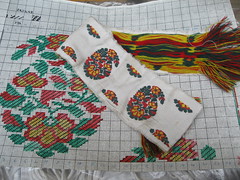
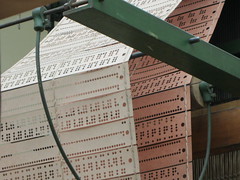
Above is a small sample of the weaving sitting on the square by square drawing of the pattern. The piece of weaving is also folded over on itself to show the multitude of  thread strands at the back, which must be trimmed and removed when the piece is complete. From the grid pattern above, cards are punched to correspond to the placement of colours. These thousands of cards are assembled and fed into the jacquard loom shown below to create the designs. According to our guide, most histories of the computer mention the jacquard looms and their binary system as part of the computer's origins.


Other interesting aspects of Paisley:
-The J.P. Coats family and the Clark family had both very large and prosperous thread producing companies. Both of these names are certainly part of my own yarn knowledge, and KnitTraders still orders Anchor Tapestry Yarn from Coats & Clark.

-The Clark company were the first to sell thread on a spool. Before that you had to bring your own spool on which they would wind the thread that was required.

-Streets in Paisley are all named for the textile trade: Cotton St. Gauze St. etc.

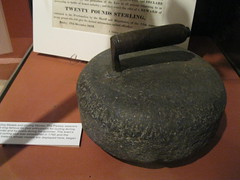
-It is believed that the very first game of curling was played here. You can certainly tell why they are called "rocks".


-People who are from Paisley are known at "Paisley Buddies".
Famous Paisley Buddies include actors David Tennant for all you Dr Who fans, and Tom Conti.


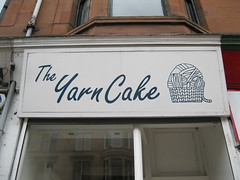
On returning to Glasgow, a good number of us got off the coach at The Yarn Cake, a lovely little yarn store with 3 tables for tea and treats. Most yarn sales in Glasgow are at John Lewis, a large department store in the city centre. The Yarn Cake is only one of 2 small knitting shops in the city. I wonder how many there were 50 years ago?

Friday, 3 May 2013

You know that you've arrived in the new Scotland when...


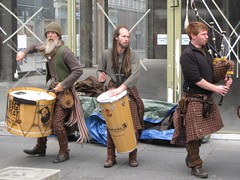
...you see buskers that look like these guys: dreadlocks, kilts of khaki and brown tartan, Army Surplus accessories and a black golf shirt! But what a sound on Argyle Street in the centre of Glasgow. A total of 5 drummers and a lone piper shaking the windows of every office building in the area.I felt bad that I was out walking by myself when I came across them. It would have been a great way for the whole group to kick start our Scottish experience.


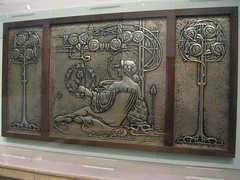
On Friday morning, we made it to Kelvingrove Museum and Art Gallery in the West End of Glasgow. As it turns out Marion, our guide who will be with us for the 11 days of our time in Scotland, is a volunteer guide at the museum and gave us a highlights tour that meant that we got a taste of the breadth of  the museum's offerings in just over an hour. It's amazing - everything from an ancient Egyptian sarcophagus to skeletons of prehistoric animals, to Salvador Dali's Christ of St John of the Cross, to a fabulously comprehensive exhibition of the works of Glasgow centered designer/architect, Charles Rennie Macintosh, whose beautiful metal wall piece above just mesmerized me.


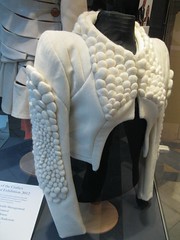
As I was hurrying to the door to make it on time for the bus, I spotted this Shibori style felted jacket. Isn't it stunning? I have no idea where it came from or what its significance is as part of the museum's collection but I had to get a picture of it for all you felting fans.

We finished off the afternoon by driving about an hour outside of Glasgow to visit New Lanark Mills. This World Heritage Site became famous originally as a model industrial community under Robert Owen from 1800-1825.  The villagers/workers at the mill (which included children who were well treated and rewarded for their labour) were provided with decent homes, schools and evening classes, free health care and affordable food. Such ideas that were at least 100 years ahead of their time and laid down the foundation for the cooperative movement which has made its way around the world.

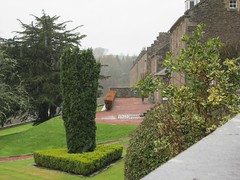
Had it not been for the Scottish mist that dogged us the whole time that we were there, we would have been able to enjoy more fully the idyllic vistas of this valley. As it was I had to content myself with this quick picture of the workers' housing. There are still a hundred or so villagers living in the town although I'm surprised that it's not more...it truly is a magnificent setting.

Monday, 29 April 2013

To Scotland...


Welcome everyone,
This is indeed the place where  I'll be sharing the happenings of the KnitTraders 2013 Scottish Knitting Tour.  Keep checking as I'll be posting every few days.

This is our third Knitting Tour, the others being to Ireland in 2011 and to Italy in 2012, conducted in conjunction with Service Guaranteed Travel and we're looking forward to another 11 days of wonder and excitement.

Also coming up, we will be giving a brief outline of possible Knit Tour destinations for 2014 and 2015 with a ball park price range. To this we would GREATELY welcome your feedback as to a preferred destination if you have the chance to join us on a tour in the next couple of years.

Needless to say, the "What's New" aspect of this blog will be taking a break for the next few weeks, but there will be plenty to follow. Will be back soon with the opening of our trip.
Anne

Saturday, 20 April 2013

Lots of New Samples to Tempt...

At this time of year, we get a chance to take a bit of a breath and look at freshening up the store samples. Here are some of the new ones:


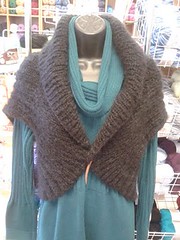
The crazy popular Mohair (or any chunky) Shrug Bolero.
Incredibly easy and looks great on everyone.
The Best Beginners Baby Blanket which Maureen has done up using 2 strands of Baby Marble DK held together. It's gorgeous and so soft for the new little one.
 
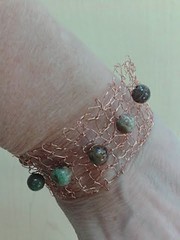
The Knitted Wire Bracelet is giving us a chance to play with our newest product
Artistic Knitting Wire.
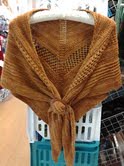
Our latest KnitTraders pattern exclusive: The Ridged Shawl. Super simple, worsted weight, practical and fashionable.